
Research & Publications
Research & Publications
1st author on a research paper titled ‘Measuring Traumatic Brain Injury Impacts in an Anatomically Accurate Rat Brain Phantom with Embedded Piezoelectric Sensing,’ submitted for publication to ASME’s Journal of Engineering Materials and Technology
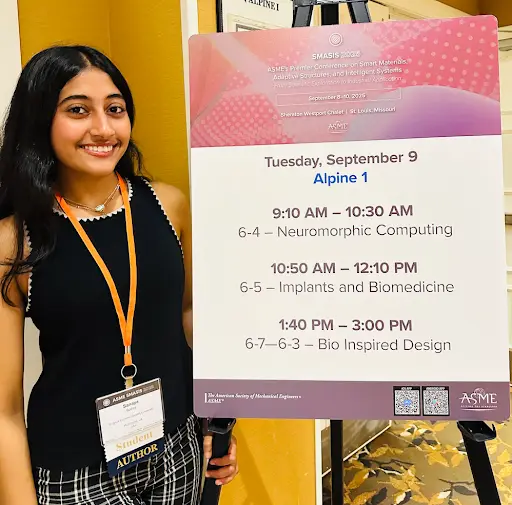
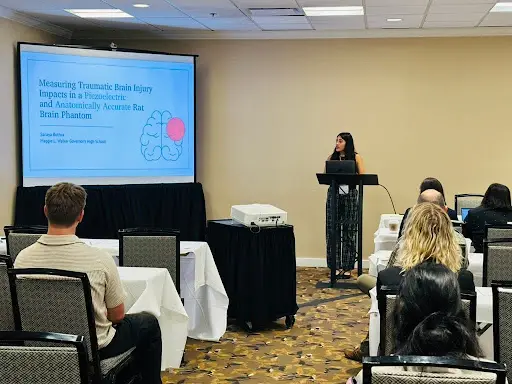
Presented at ASME's premier conference: “Smart Materials, Adaptive Structures, and Intelligent Systems,” - September 2025
Traumatic brain injury (TBI) remains a prevalent cause of injury or death each year, due to the temporary and permanent effects of external forces damaging the brain. 67% of U.S. military veterans have experienced at least one TBI. To better study these effects, an anatomically accurate, piezoelectric rat brain phantom was developed to understand the effects of such forces on brain tissue and guide the creation of future protective measures and treatment options.
This hydrogel-based brain phantom functions as a viscoelastic model, replicating both the mechanical deformation and electrical signaling of brain tissue under force. The composite material, formulated from polyvinyl alcohol (PVA) and phytagel (PHY), matches the viscoelastic properties of brain tissue, as confirmed through rheological measurements of storage and loss moduli. A piezoelectric polyvinylidene fluoride (PVDF) film embedded within the phantom helps measure the mechanical impacts of force into electrical signals of current. Under applied impulse and force, the system demonstrated a non-linear increase in current and strain rate, representative of changes in severity of the traumatic brain injury.
This novel innovation offers an accessible platform for studying TBI impact forces, with potential applications in neurotrauma research, designing protective equipment, and the development of neuromorphic devices. Furthermore, this provides researchers with the means to determine the thresholds that lead to injury, allowing for more accurate prediction of TBI outcomes.
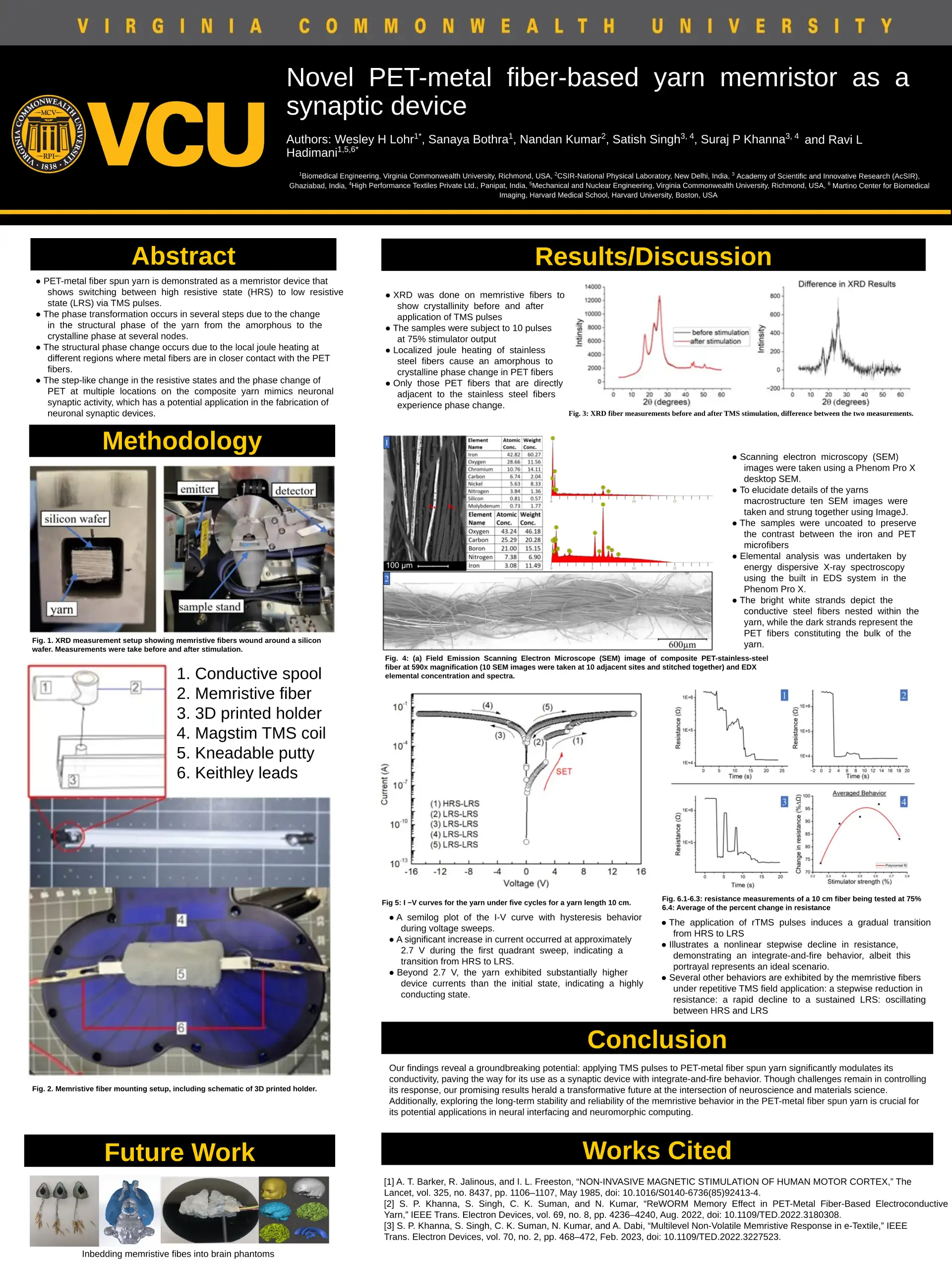
2nd author on a research paper on ‘Novel PET-Metal Fiber-Based Yarn Memristor as a Synaptic Device,’ published by the IEEE’s Transactions on Magnetics Journal

Presented at Annual IEEE Engineering in Medicine and Biology Society Conference - July 2024
Mental health remains a pertinent issue in today’s society and 1 in 5 adults struggle with a mental health disorder.
Transcranial magnetic stimulation (TMS) is a solution that offers a non-invasive, promising treatment for a range of mental health conditions like depression, OCD, and PTSD, especially for patients unresponsive to traditional therapies. However, accurate brain model to practice TMS does not exist, so administration of TMS treatment is done directly on patients, which limits our ability to experiment for advancement and optimization of TMS.
To address this, replicas of the brain, known as ‘brain phantoms’, have been created, and my research task focused on testing a new fiber-based synaptic device that is integrated into the brain phantoms to determine if it can replicate the integrate-and-fire behavior of neurons, thereby improving the anatomical accuracy of the brain phantoms on which TMS simulation can be performed.
To characterize the ability of this fiber to mimic neuronal behavior, TMS stimulations were pulsed at 25%, 50%, 75%, and 100% strengths (in amps), and the resistive response was measured. After the experiment concluded and the data was analyzed, a pattern emerged in three of the four magnetic field variables, showing excitation and damping in the oscillation of resistivity. However, this pattern was most dominant at 75% of the complete magnetic field. It was summarized that the resistive characteristics of the synaptic device resembled those of neurons when the magnetic stimulation was 75%. Typically, a waveform of the firing signals would show oscillating peaks with a steeper increase and a more shallow decrease. From the data, the pattern represents the gradual decrease of resistivity while still creating peaks at each pulse.
Thus, knowing the range in which this neuron-like fiber displays similar behaviors is crucial for improving the accuracy of brain phantoms and implementing this device in other fields such as neuromorphic computing and neural prosthetics.
Click below for details on the full paper.
Abstract/Paper