
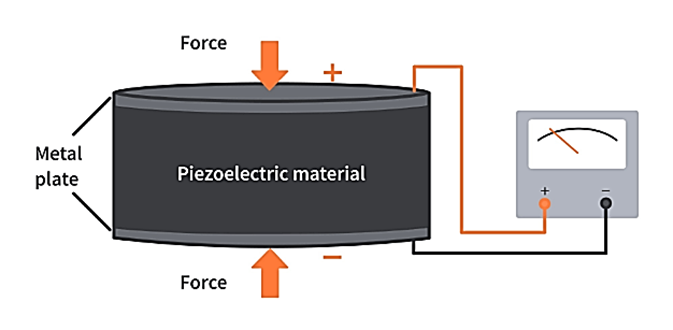
Surprisingly, some materials have the ability to convert pressure into electrical energy. Piezoelectricity is one of them, it is a term for electricity produced by latent heat and pressure. It comes from the Ancient Greek words πιέζω (piézō), which means “to squeeze or press,” and ἤλεκτροv (ḗlektron), which means “amber” and refers to an old source of static electricity. A material that acquires charge in reaction to mechanical stress is known as a piezoelectric substance. The effect is bidirectional, meaning that an applied electric field can cause mechanical stress.
There are numerous applications for piezoelectric devices like ceramics. Piezoelectricity requires ferroelectricity in ceramics with randomly aligned grains. Because the tiny structure of piezoceramics exhibiting abnormal grain growth (AGG) is typically made up of a few abnormally large elongated grains in a matrix of randomly oriented finer grains.
Piezoelectric polymers are flexible plastics that, when twisted or stretched, produce electricity. Polymers are pliable and squishy, in contrast to ceramics or crystals. Because of this, they are ideal for wearable devices, such as fitness trackers that use the energy from your steps to function.
Despite the fact that polymers have properties that ceramics do not, their piezo-response is not as high. Because of their flexibility and lower acoustical impedance, non-toxic, piezoelectric polymers have been researched and used during the past few decades. Bulk polymers, voided charged polymers (also known as “piezoelectrets”), and polymer composites are the three categories of piezoelectric polymers. The molecular structure of bulk polymers is mostly responsible for the piezo-response they exhibit. Bulk polymers can be classified as either semi-crystalline or amorphous. Piezoelectric composites have been suggested as energy harvesters and nanogenerators because of their versatility.
https://www.sciencedirect.com/topics/materials-science/piezoelectric-material
https://www.allelcoelec.com/blog/exploring-piezoelectric-materials-types,properties,and-technological-impact.html?srsltid=AfmBOooo2GExjDnoTg_3fCQ0CEffH9jMpruWg2wmPUkE5cvefcPKLLV5
https://onlinelibrary.wiley.com/doi/abs/10.1002/crat.202200130
