
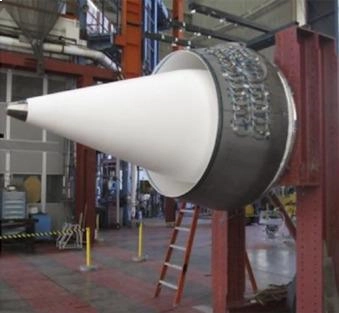
Composite materials are presently used in over 27% of Airbus A380 aircraft, plus 53% of Boeing 787 aircraft, indicating a considerable growth in their use. Composite materials have a lot of promise for use in engine parts as well as for building purposes. Because composite materials have a higher specific strength and better resistance to corrosion and fatigue than most metals, they are increasingly being used in the aircraft sector.
There are different kinds of composite materials used in aerospace, some of which are discussed below;
The past few years have seen a lot of research into ceramic matrix composites (CMC), due to their appealing qualities, which include having high-temperature core strength, strong toughness, resistance to corrosion, and good adaptability. Ceramic matrix composites are typically utilized in aircraft exhaust nozzles and other high-temperature regions. A possibility for aircraft brakes, where the temperature could rise to 1100 to 1200 °C in critical situations, is carbon fiber reinforced silicon carbide. Metal matrix composites are said to have poor fracture toughness despite their advantages.
Another composite is a metal matrix composite. Because of their appropriate wear resistance, low thermal expansion, fracture toughness, and reinforced greater yield strength, metal matrix composites (MMCs) have great potential for the aerospace sector. Aluminum, titanium, nickel, copper, and magnesium are among the metals and alloys that have recently been investigated as matrices. The possibility of certain fibers, like ordinary carbon fiber and ceramic reinforcement, to enhance MMC’s qualities was studied. These fibers, however, are unable to satisfy the demands for additional enhancement of MMC’s mechanical qualities. The need for fibers with greater strength, a lower coefficient of thermal expansion, improved self-lubrication, and a stronger damping capacity has made carbon nanotubes (CNTs) and graphene nanosheets more appealing recently.
Based on the variations in matrix properties, polymer matrix composites (PMCs) can be divided into two groups, i.e., thermoset and thermoplastic. The well-known high specific strength and specific modulus of polymer matrix composites are their primary benefits. For instance, the density of epoxy composite enhanced with carbon fiber (CF) is only half that of Al-based alloys, but the elastic modulus and tensile strength are two and three times more, respectively, than those of Al-based alloys. Applications for thermoset and thermoplastic PMCs in aeronautical structures, including landing-gear doors and ailerons, have been documented. Because of their high strength, elastic modulus, and capacity to withstand high temperatures, polymer matrix composites (PMC), including CFRP, have been increasingly popular for use in aircraft constructions in recent years.
https://www.sciencedirect.com/science/article/abs/pii/S0376042117301483
