
Have you ever considered how awesome it would be if your brain could be directly connected to a computer? Or what if someone could simply think about moving a robotic arm? Thanks to conductive polymers and hydrogels, researchers are coming closer to making that a reality. These are unique substances that function similarly to the tissue found in our brains. Like our neurones, which are the cells that enable us to think and move, they are soft, pliable, and electrically charged.
Now you’ll be thinking that what Conductive Polymers really are? Actually Polymers are materials made of long chains of molecules. Rubber and plastic are two examples of materials that contain them. They don’t normally conduct electricity. However, some of them can transmit electrical information when scientists alter their structure. We refer to these as conductive polymers.
Imagine combining these polymers with water to form a hydrogel, which is a soft substance that resembles jelly. It turns into a conductive hydrogel when it is able to conduct electricity as well. Because they feel more like actual brain or nerve tissue, these soft materials are fantastic.
Electricity is used by our brain to transmit signals. Electrical signals are sent from your brain whenever you move, think, or experience anything. These signals are attempted to be connected by devices such as neuroprosthetics (brain-controlled robotic limbs) or brain-machine interfaces (BMIs).
However, the issue is Silicon and metal (the hard materials used to make most electronics) are too rigid for the sensitive, fragile brain. These may become damaged or cease to function properly with time. Because conductive polymers and hydrogels are flexible enough to mimic brain tissue while yet having the ability to transmit impulses, scientists are now employing them. Both worlds are best combined.
By recording and transmitting signals to the brain, these materials can be utilised to improve brain-computer connections for tasks like communication or gaming, build neuroprosthetics that allow users to move artificial arms or legs with their minds, and aid in the treatment of brain disorders. They even aid in the growth of nerve cells, which is very beneficial for the recovery process following an injury.
According to my recent researches, Scientists are evaluating these materials on animals and in preliminary human investigations, Certain hydrogels are so sophisticated that they can be applied to the brain to record signals without hurting or causing damage. Additionally, scientists are trying to make them biodegradable so that, when no longer needed, they can safely decompose. Optimising hydrogels’ conductivity, stability, and biocompatibility without sacrificing their suppleness and stretchability still presents difficulties. Since conductive hydrogels might degrade, expand, or lose their conductivity over time, long-term durability in physiological settings is still a major concern.
And you know what the best part is? People may use mind-controlled gadgets in hospitals or at home in the future. People, who have lost their ability to walk, communicate, or even see may be able to regain their skills with the aid of these products. Smart materials that behave more like humans, such as conductive polymers, make all of this possible.
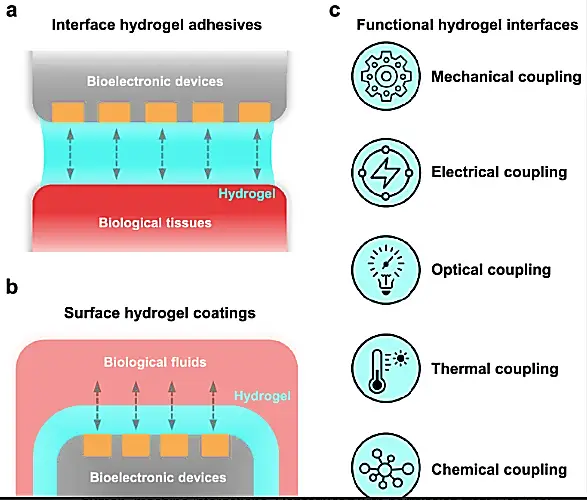
(a)Representation of a hydrogel interface that allows electronic devices and biological tissues to communicate seamlessly. (b) Illustration of a hydrogel coating that is applied to a device to improve its functional performance and biocompatibility. (c) An overview of the main characteristics of hydrogel that improve human-machine interactions: mechanical adaptability, conductivity, transparency, heat regulation, and chemical reactivity.
https://www.mdpi.com/2310-2861/11/4/232#B34-gels-11-00232
https://pubs.acs.org/doi/abs/10.1021/accountsmr.1c00142
