
The strength or flexibility of materials like glass, metals, and plastics are frequently the first things that come to our minds. However, the optical characteristics of materials are among their most intriguing and significant features. Any substance that has the ability to modify or regulate electromagnetic radiation in the visible, infrared, or ultraviolet (UV) spectral ranges is considered an optical material. Light can be refracted, reflected, transmitted, dispersed or transformed using these materials, which are manufactured into optical elements.
Let’s take an example of a glass. Your home window’s glass is made to let in visible light while keeping out dangerous ultraviolet (UV) radiation. Sunglasses, on the other hand, shield your eyes from excessive light by reflecting or absorbing it. The secret to having it function in both situations is regulating the way light passes through the substance.
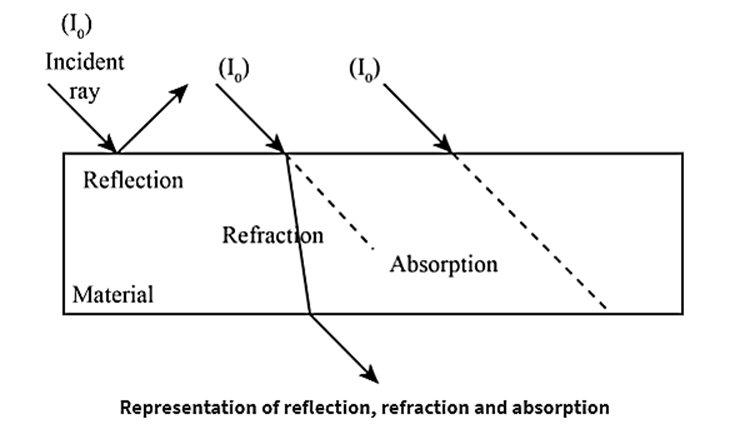
When exposed to electromagnetic radiation, many materials exhibit varying optical properties. The optical characteristic of a material is its reflectivity. The phenomenon known as “refraction of light” occurs when a light wave strikes a polished surface of a substance and bounces back off the surface. When a light beam strikes a substance, however, a portion of the incident beam is absorbed by the material; this phenomenon is called absorptivity. Light bends whenever it passes through a medium; this indicates that the incident light ray’s path changes after interacting with another material. This attribute of the material is called refractivity, and the phenomenon is known as the refraction of light.
Transparency is a material’s optical characteristic that allows for clear visibility of an object when it is placed on one side of the material and a light wave strikes the other side. However, some materials do not let electromagnetic light waves to flow through them, hence light waves cannot travel through them. The nature of this kind of substance is neither translucent nor transparent. Materials such as wood, sand, metals, etc. are referred to as opaque materials.
https://www.bartleby.com/subject/engineering/mechanical-engineering/concepts/optical-properties-of-materials
https://www.numberanalytics.com/blog/optical-properties-in-electrical-properties-of-materials
