
Materials created with inspiration from nature are known as biomimetic materials. The design of composite materials might benefit from this. Human constructions have been inspired and innovated by natural formations. The beehive’s honeycomb structure, spider silk’s strength, bird wing mechanics, and shark skin’s ability to resist water are notable examples of these natural systems. The study and emulation of natural processes, systems, and approaches to address difficult human issues is known as biomimicry. Through environmental adaptation, bionic structures have evolved to offer the advantages of dexterity, light weight, and stability. Consequently, bionic structures are frequently employed to enhance and refine bonding structures.
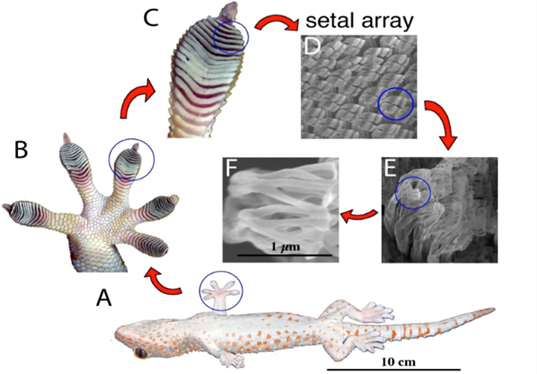
According to some researchers, the sticky protein layer of Mytilus californianus featured a lot of pores and voids, just as the cavities in the concave nanomembranes at gecko toes. They created “sacrificial cracks,” which are manufactured flaws in the bonding line, based on the cavities and porosities in the two bonding systems. It was discovered following a number of experimental analyses. The outcomes demonstrated that the produced glue had great adhesion, stability, and adaptability.
A traditional illustration of the microanatomy of nacre, the mother of pearl, is a “brick-and-mortar” setup. Pearls are also composed of nacre, which is the inner lustrous mother-of-pearl coat found in various shells. Using a sol-gel process, glass-ceramic nanoparticles were created and utilized to create biodegradable materials for applications involving tissue engineering. Based on the nacre structure, these nanoparticles were also utilized to create bioactive coatings. High concentrations of various functional groups can be obtained using self-assembled monolayers as model substrates for the production of compounds with biological inspiration. Nacre and materials produced from it also interact well with bone, which makes them appealing in the biomedical industry. New materials and coatings with better mechanical qualities have been created using bioinspired techniques to mimic some of the structural characteristics of nacre.
Spider silk is a naturally occurring polymeric fiber that exhibits unique thermal, optical, and biodegradable qualities in addition to high tensile strength and durability. Spider silk’s hierarchical structure, which includes the primary and secondary frameworks of the spidroins (spider silk proteins), the nanofibril, the “core–shell,” and the “nano-fishnet” frameworks, is responsible for its mechanical qualities. Furthermore, spider silk has exceptional qualities in terms of light transmission, heat conductivity, retention of water, humidity/water response, and shape-memory function. Huge molecular weight proteins, usually ranging from 250 to 400 kDa, spiders have different sequences based on the species and the kind of silk.
https://royalsocietypublishing.org/doi/10.1098/rsta.2009.0007
https://www.sciencedirect.com/topics/engineering/biomimetic-adhesive
https://advanced.onlinelibrary.wiley.com/doi/full/10.1002/advs.202103965
