
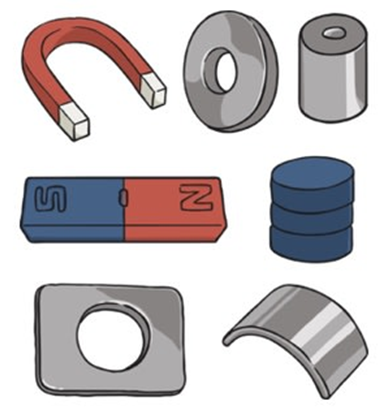
The force that magnets exert when they are attracted to or repelled by one another is called magnetism. The movement of electric charges is what generates magnetism. Atoms are the minuscule building blocks that make up all substances. Electrons are charged particles found in every atom. The electrons orbit around an atom’s nucleus, or core, spinning like tops. Each electron behaves as a little magnet as a result of its mobility, which creates an electric current.
Both the south and north poles are present in all magnets. Although the same poles repel one another, opposite poles are drawn to one another. A magnetic field is produced by the force produced by the aligned atoms. The iron fragment has turned into a magnet. Explaining how materials react to magnetic fields is the most effective way to introduce the many forms of magnetism. Let’s discuss it.
The non-cooperative behaviour of orbiting electrons in the presence of an applied magnetic field is an indication of diamagnetism. The magnet is repelled by diamagnetic metals, although the force is usually quite modest.
The phenomenon of para-magnetism arises when certain atoms or ions in a material possess a net magnetization because of unpaired electrons in partially filled orbitals, such as iron. The atomic magnetic moments are now partially aligned in the path of the field when a field is present, leading to a net positive magnetization.
Ferromagnetic materials are those in which atomic moments align either parallel or antiparallel due to interactions created by electronic exchange forces. Strong interactions are seen in it. A magnetic structure called ferrimagnetism, which is made up of two magnetic sublattices that are disconnected by oxygen atoms. It’s similar to the crystal structure of ionic substances, such as oxides, that can give rise to more intricate types of magnetic ordering. The net moment is 0 if the sublattice moments of two particles, let’s say A and B, are precisely equal but opposite.
Antiferromagnetism is the term for this kind of magnetic ordering. Materials classified as magnetic are those that are drawn to a magnet. Since items composed of metals such as nickel, iron, and cobalt are drawn to magnets, these elements constitute the magnetic substances. Depending on the strength of the magnetic field required to align the magnetic domains, ferro- or ferrimagnetic material can be either a hard or a soft magnet. Although they can be magnetized, “soft” magnetic metals quickly lose their magnetic properties. Hard magnetic metals, such as Alnico alloy, an iron alloy containing nickel, cobalt, and aluminum, have a tendency to remain magnetized for extended periods of time.
Strong permanent magnets are made from AlNiCo alloys. Large electric motors, electric guitar pickups, microwaves, and loudspeakers are a few examples. Electricity is necessary for electromagnets to function. Magnetic resonance imaging (MRI) devices and particle accelerators are examples of advanced electromagnet applications.
https://education.nationalgeographic.org/resource/magnetism/
