
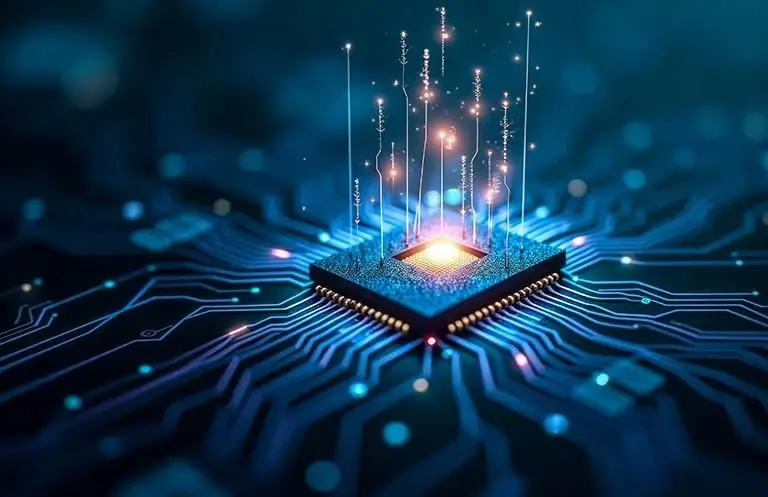
Have you ever thought about the operation of your computer, phone, or even your vehicle? All of these devices make use of semiconductors, which are incredibly tiny but incredibly powerful. Modern technology is made possible by these small materials. There wouldn’t be any computers, smartphones, or even the internet without semiconductors!
You may now wonder what a semiconductor is and how it actually functions. Let me tell you semiconductors are a unique class of material that, in certain situations, may conduct electricity but not in others. This distinguishes it from an insulator (like rubber), which prevents electricity from flowing, and a conductor (like copper), which always permits electricity to flow. Semiconductors are essentially smart gates that have the ability to determine whether to allow and prohibit electricity.
The electrons in a semiconductor, such as pure silicon, are firmly kept in place, making it a poor conductor of electricity on its own. However, through the process of doping, which involves adding a very little quantity of another element (such as phosphorus or boron), an intriguing phenomenon occurs. Combining phosphorus and boron can act as a switch to regulate the flow of electricity. Let’s take a closer look at how this happens.
The substance has free electrons to travel about because phosphorus has extra electrons. Boron, which has less electrons than other semiconductors, produces “holes” that draw electrons, hence the term “n-type” (negative-type) semiconductor. P-type, or positive-type, semiconductors are what this is known as. This regulates the flow of electricity and is known as a PN junction. This is how diodes and transistors function.
At a rate of millions or even billions of times per second, the transistors switch on and off. That’s how information is processed on your computer or smartphone. It is possible for a single semiconductor chip to include billions of transistors.
The fundamental components of all contemporary electronic gadgets are semiconductors. We wouldn’t have smartphones, tablets, laptops, solar panels, LED lights, medical equipment, or electric cars without them. Semiconductor technology is even used in devices like microwave ovens, ATMs, and traffic lights. To put it briefly, our digital world is powered by semiconductors.
The need for faster and better semiconductors is growing along with technology. Researchers are trying to create semiconductors that are even faster, smaller, and use less energy. Advanced semiconductor technology is essential to future technologies like space exploration, self-driving automobiles, quantum computing, and artificial intelligence (AI).
http://www0.cs.ucl.ac.uk/staff/P.Rounce/myhtml/gc03/hardware_handbook/transistor.pdf
https://books.google.com.pk/books?hl=en&lr=&id=0hdREAAAQBAJ&oi=fnd&pg=PR11&dq=Orton,+J.W.,+The+story+of+semiconductors.+2008:+OUP+Oxford.&ots=3PVa8TBn_j&sig=z96IGb0bIy5bCeZ1C_Eaju1AUXE&redir_esc=y#v=onepage&q=Orton%2C%20J.W.%2C%20The%20story%20of%20semiconductors.%202008%3A%20OUP%20Oxford.&f=false
